Billing and revenue
Product catalogue, invoicing, dunning and accounting exports in one billing engine, on the TM Forum SID model.
SID data model
The product catalogue follows TM Forum's SID (Shared Information/Data) model, so partners and connectors share one vocabulary for products, customers and orders.
Offers, prices, taxes and booking accounts live in one catalogue built on the SID model.
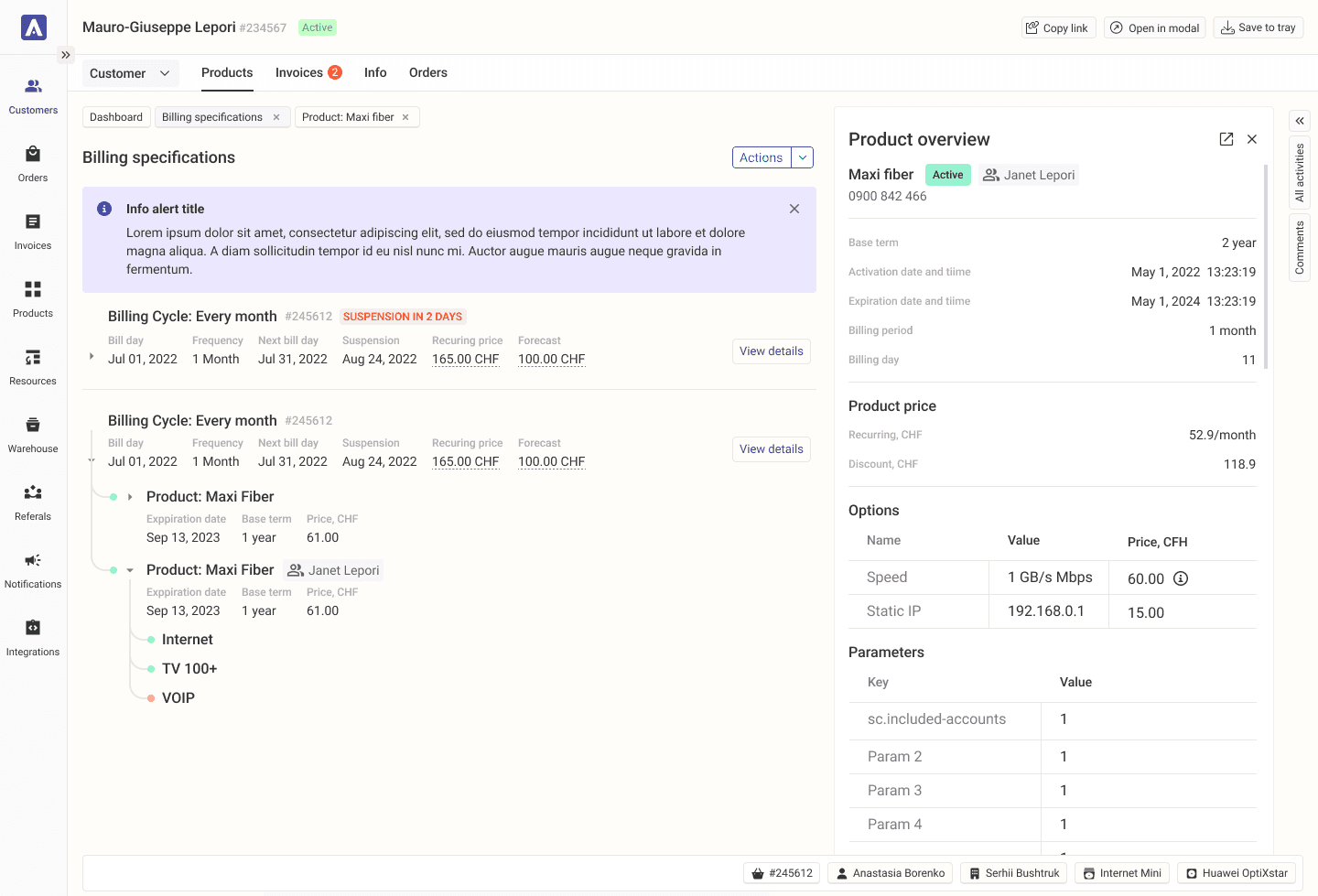
TM Forum compliant product catalogue
- Tax mapping per price type
- Map specific tax rates to each price type in your catalog: recurring charges, one-time fees, and usage-based prices each with their own tax treatment.
- Booking accounts for accounting
- Assign booking accounts (Erlöskonten) to each price type so revenue lands in the right account in your accounting system.
- Booking rules
- Customize booking accounts with rule-based logic: route revenues based on service properties, customer ZIP code, customer type (individual vs. company), and more.
One chain from offer to network
From the offer your customer sees down to network provisioning: one chain.
- 1
Customer-facing offers
Products and bundles as your customers see them in the shop and portal.
- 2
Hardware per technology
Supported devices (routers, ONTs, SIM cards) mapped to each access technology.
- 3
Service bundles
Compose complex bundles combining internet, voice, TV, and value-added services.
- 4
Service connectors
Provision and activate services on the network via typed service connectors.
Party roles
In TM Forum terminology, a "Party" represents any individual or organization. METAVSHN implements an N:N role model that maps real-world relationships.
Each person in the system can hold multiple roles of different types, connected to different accounts. This enables complex scenarios like families or companies where billing, management, and service consumption are handled by different people.
- Customer role
- Pays invoices, manages subscriptions, has full account access and signing authority.
- User role
- Consumes services, sees only their own usage data and mobile plan in the customer portal.
Family
A typical family setup where one person manages and pays for all subscriptions while each family member accesses only their own services.
- Parent: customer role
- Sees all invoices, manages all family subscriptions, receives one consolidated bill.
- Family members: user role
- Each member logs into the portal and sees only their own mobile plan usage and consumption data.
Company
A company owner with signing authority holds the Customer role, while employees are assigned User roles for their individual lines, each with portal access scoped to their own services.
Billing cycles and dunning
Define billing cycles and dunning rules tailored to your telecom operation.
- Monthly
- Standard monthly billing run on a fixed date.
- Quarterly
- Aggregate charges over three months for larger accounts.
- Free-form
- Each customer has their own billing run on their individual anniversary date.
Dunning and service lifecycle
You set the rules for reminders, suspension and reactivation, and which channel each step uses.
- Email reminders
- SMS notifications
- Paper letters
- Automatic suspension after configurable grace periods
- Automatic reactivation upon payment receipt
Several billing accounts per customer
Separate billing concerns with independent accounts.
Each billing account has its own cycle, payment method and invoice stream, for example one per department, or one for private and one for business services.

Accounting with Bexio
METAVSHN sends invoices to Bexio, the Swiss cloud ERP, and reads payments back, so your accountant keeps working in the tool they already use.
See the Bexio integration- Automatic invoice sync to Bexio
- Payment matching and reconciliation
- Financial reporting and tax exports
Using a different ERP? We build connectors for other accounting systems too.
See billing run on your own service types
Catalogue, invoicing, dunning and accounting exports in one billing engine.